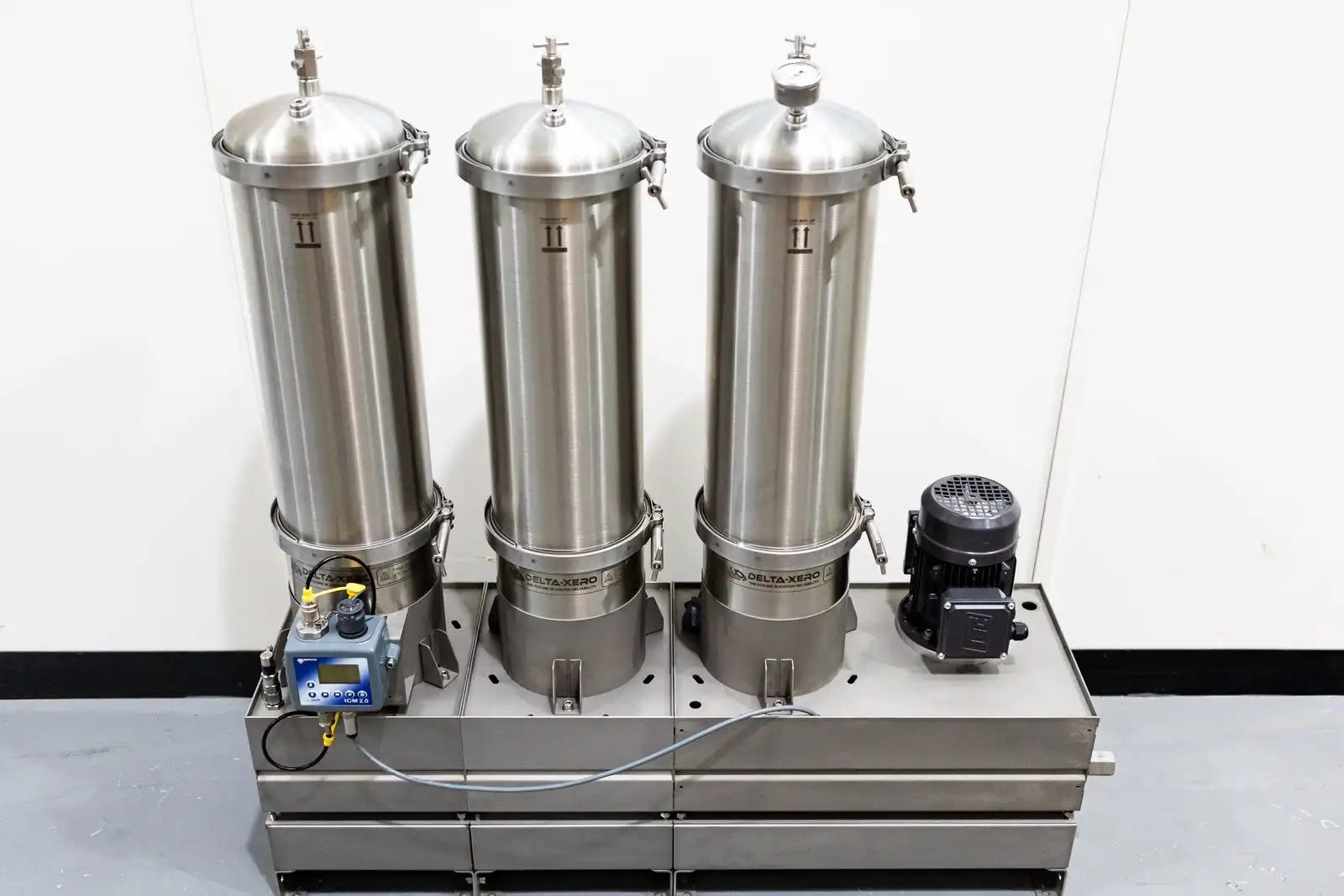
Does filtration remove the additives?
When we talk about filtration down to 0.1 µm, one of the first questions is whether the filter also takes the additives that protect the machine. It is a sensible question. The answer is no, and here is why, and what an independent laboratory found.
Why does the filter not remove the additives?
The additives are dissolved in the oil. They exist as molecules spread through the whole oil, not as particles. A filter captures what is larger than its pores: particles, sludge, varnish and water droplets. Dissolved substances pass through with the oil.
It is the same principle as sugar dissolved in coffee. The coffee filter holds back the grounds, but the sugar runs straight through.
What did the study by POLARIS Laboratories show?
POLARIS Laboratories, an independent oil laboratory, followed the oil in a Jenbacher J316 gas engine running on landfill gas with Delta Xero filtration. The oil was an SAE 40 gas engine oil with a base number of about 4.5 when new. Over 8 weeks, 14 samples were taken and analysed for base number, acid number, pH and oxidation:
| Measurement | First sample | Last sample | Range across all 14 samples |
|---|---|---|---|
| Base number (BN) | 3.1 | 3.8 | 2.7 to 5.2 |
| Acid number (AN) | 2.88 | 2.05 | 1.08 to 2.88 |
| pH | 5.3 | 6.1 | |
| Oxidation | 8 | 7 | 7 to 8 |
The laboratory’s conclusion is based on the thousands of oils from landfill gas engines it analyses every year: there is no abnormal trend. If filtration removed the additives, the base number would fall much faster and the acid number would rise sharply. That did not happen.
What do base number and acid number measure?
| Measurement | What it shows | What happens as the oil ages |
|---|---|---|
| Base number (BN) | How much of the acid-neutralising additives remains | Falls slowly |
| Acid number (AN) | How many acids have formed in the oil | Rises slowly |
In a gas engine on landfill gas, acids form in the crankcase, and the additives neutralise them. When the base number reaches the engine manufacturer’s limit, the oil must be changed. It is therefore the figure that would be the first to reveal it if the additives disappeared.
What do other measurements show?
On three gas engines at a British power producer, the oil change interval was extended from about 150 to an average of 650 operating hours with filtration and close sampling. Base number and acid number stayed within the engine manufacturer’s limits throughout, with a base number of 4.5 and 3.9 and an acid number of 1.5 and 1.6 in the two samples in the case study.
On a large hydraulic power unit, independent laboratories examined viscosity and additives before the customer bought a fixed unit. They found no negative effect.
So what does the filter take?
What is not dissolved: particles down to 0.1 µm, free and emulsified water, sludge and varnish. That is exactly what wears components and breaks down the oil. By removing it, the oil can last longer, as the gas engines with oil changes after 650 instead of 150 operating hours show.
If the oil contains solid additions that are not dissolved, such as graphite, talk to us before filtering.
How do you check it on your own system?
Follow base number and acid number in the oil analyses before and after installation. If they stay on the same curve as before, the additives are still there. That is also what the samples in a pilot programme document.
Questions and answers
Does a 0.1 µm filter remove the oil's additives?
No. The additives are dissolved in the oil at molecular level and pass through the filter. An independent study by POLARIS Laboratories on a gas engine showed that base number and acid number followed normal degradation with filtration, and that the additives were not removed.
What is base number (BN)?
The base number measures how much of the oil's alkaline additives remain to neutralise acids. It falls slowly while the oil is in service. If it falls below the engine manufacturer's limit, the oil must be changed.
How can I check myself whether the additives are being removed?
Follow base number and acid number in your oil analyses before and after installation. If the filter removed the additives, the base number would fall much faster than normal and the acid number would rise sharply.
Does filtration affect viscosity?
No. On a large hydraulic power unit, independent laboratories examined both viscosity and additives and found no negative effect.
Documented in the case studies
Gas engines and biogas
Independent laboratory: the filtration does not remove the engine oil additives
3.13.8
Base number, BN (first and last sample)
Read the caseGas engines and biogas
Gas engines on landfill gas: oil changes from about 150 to 650 operating hours
about 150 (weekly)650 on average
Oil change interval (operating hours)
Read the caseManufacturing and industry
ORE Catapult: over 24 kg of sludge out of the hydraulic oil despite a 3 µm inline filter
in the oil despite a 3 µm inline filterover 24 kg removed
Sludge, varnish and debris removed in 6 months
Read the caseWant to know the figures for your own system?
We are happy to take a sample and go through the figures with you.