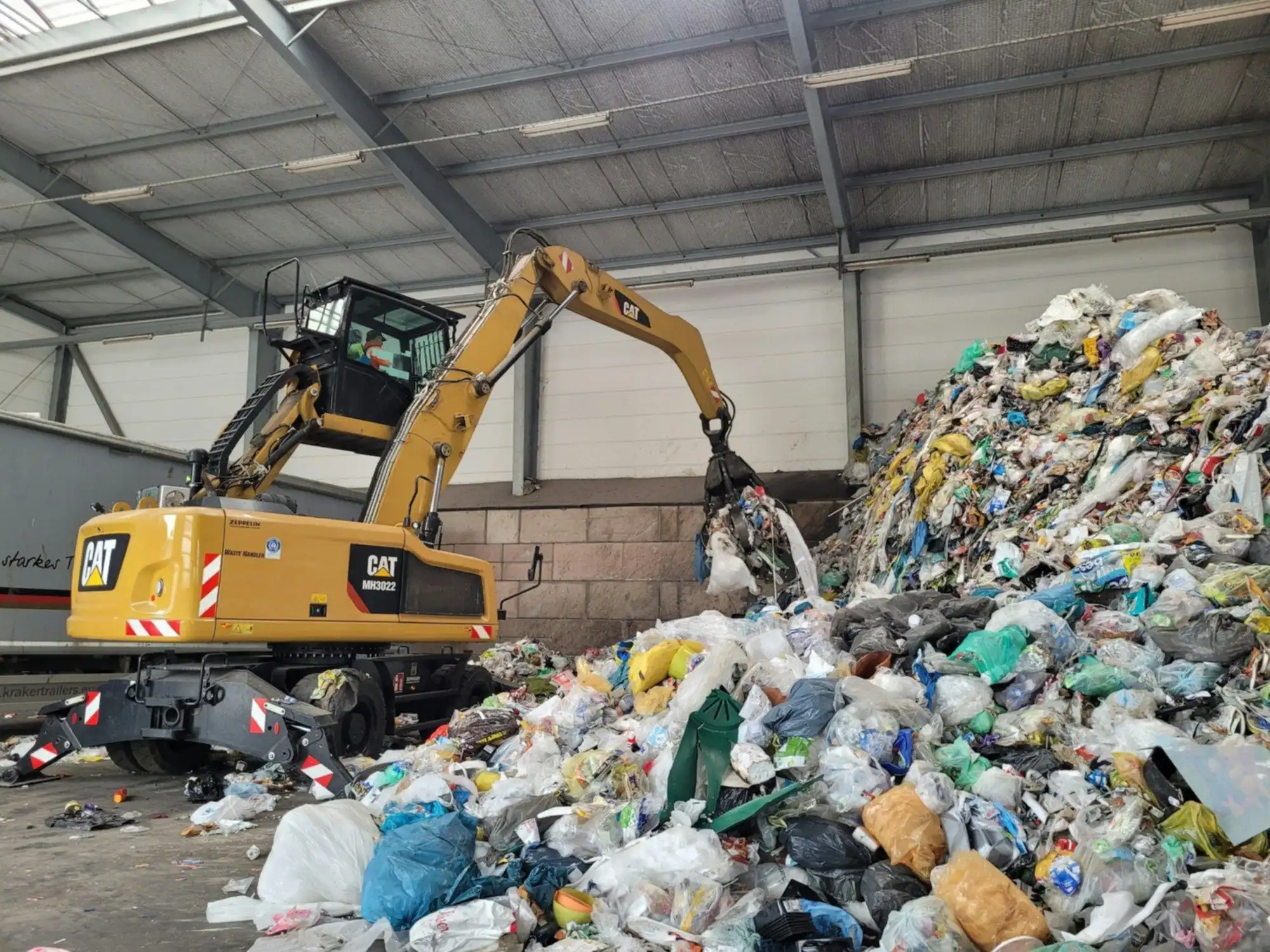
Recycling and waste: oil in a dusty environment
Balers, machinery and gas engines in the waste sector work amid dust, fibres and abrasive gas. The contamination ends up in the oil. An offline filter cleans it continuously while the equipment runs.
Balers and hydraulics
In a recycling facility the air is full of dust and paper fibres, and they find their way into the hydraulic oil. At Biffa, this led to five pump and valve failures in a new baler's first six months, before oil analysis found the cause.
Gas engines on landfill gas
Landfill gas carries silicon and other abrasive substances into the engine oil. The silicon level normally determines the oil change, and on a CAT 3516 that means a change roughly every 200 hours.
Offline filtration removes the coarse, abrasive particles, so the oil can stay in the engine longer.
Cleaned in a kidney loop while the equipment runs
A Delta Xero system is connected to the hydraulic tank or the engine's oil system. Particles down to0.1 µm, free and emulsified water and sludge stay in the cartridge.
Documented on real installations
At Biffa, the cleanliness code fell from ISO 22/19/13 to 17/15/12, and there has not been a fluid-related failure since the installation. At Enovert, a CAT 3516 on landfill gas ran 907 hours on the same engine oil, against the usual figure of around 200.
Case studies from the industry
Biffa: five breakdowns in six months, none since
22/19/1317/15/12
ISO 4406 cleanliness code
Read the caseEnovert: 907 operating hours on the same engine oil, against approx. 200 normally
191 to 216 hours907 hours
Operating hours on the same oil
Read the caseLandfill gas engines: 67 % fewer oil changes
67.4 %
fewer oil changes in the field test
Read the caseStart with an oil sample
We analyse the oil samples ourselves, so results arrive within a few days. If the numbers show a problem, the pilot programme runs with samples before and after.
Contact us, or call76 20 80 10.