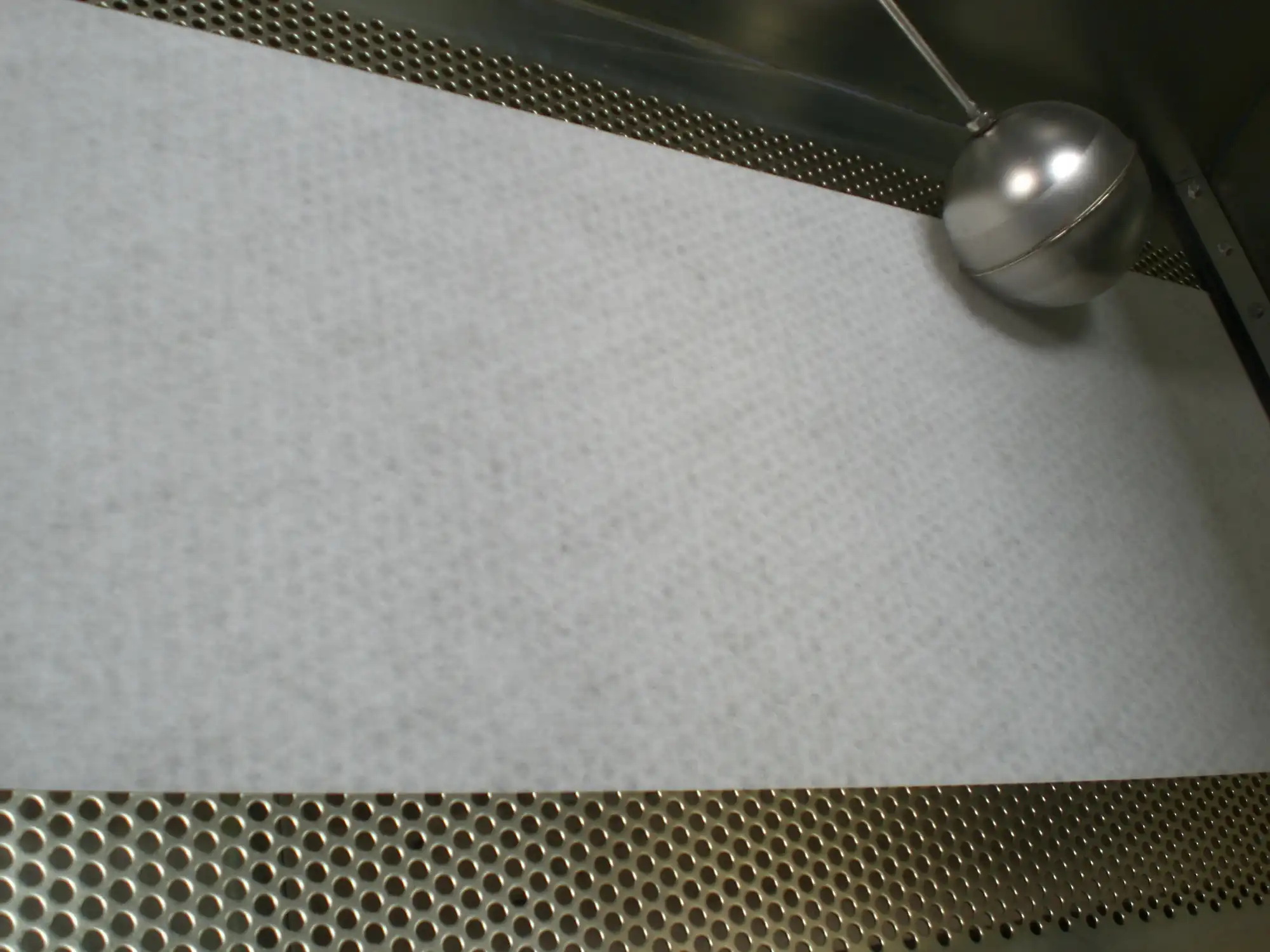
White filter paper on a perforated plate in a belt filter

Filter paper for paper bed filters and industrial liquid filtration

Filter paper is the roll medium in belt, gravity and vacuum filters that clean coolants and process fluids in metalworking. We stock 7 series in viscose, polyester and polypropylene — 39 variants from 20 to 400 g/m², in standard widths from 0.39 to 1.0 m.

7series under our own brand
39variants with a full datasheet
20–400g/m² weights
0.39–1.0 mstandard widths — above 1 m made to order

How to choose — in the right order

Most people start with the filtration grade ("I need something fine"). That is the last thing to lock in, not the first:

1. The system. Gravity filter systems let the fluid run through under its own weight — too dense a medium causes backflow and floods the belt. Vacuum systems pull the fluid through and can handle denser media and thus finer filtration.

2. The fluid. Standard fluid → viscose or polyester. Aggressive chemistry (acids, alkalis, solvents) → polypropylene.

3. The job. Only now come grade and weight — coarse for turning and drilling, fine for grinding, honing and lapping.

Two common mistakes

Choosing too fine "to be on the safe side". A denser paper than the job requires means a higher pressure drop, more frequent changes and poorer fluid flow. Finer is not better — the right grade is better.

Keeping the same paper when the process changes. If the machine switches from coarse turning to fine grinding, the requirement changes. Review the paper choice when the process moves.

If in doubt, the label on your current roll is the shortcut: it usually carries weight, material and dimensions. Send a photo of it and we will match the paper.

Recommendation table: filtration grade and system type
Filtration gradeTypical processesGravity systemsVacuum systems
Coarse (~150–200 µm)Turning, drilling, milling, coarse wire drawingUTV 20 · UTN 40 K1UTP 40
Medium (~100–150 µm)Drilling, milling, grinding, medium wire drawingUTV 35 · UTV 50 · UTN 60 K1 · UTN 80 HF · UFusion 70 · UJet 70UTP 50 · UTP 70 · UTN 80 HF · UJet 70 · UFusion 70
Fine (~50–100 µm)Grinding, honing, lapping, fine wire drawingUTV 60 · UTN 130 HF · UJet 100 · UFusion 100 · UTN 150 K1UPP 70 · UJet 100 · UTN 130 HF · UTN 150 K1 · UFusion 100
The table is indicative. All values are averages subject to normal production tolerances — contact us for advice on your specific process.

Depth filtration: the paper works in three dimensions

Belt filter paper is a depth-type medium: particles are captured inside the fibre structure, not only on the surface. And the particles already held in the medium help capture new ones — the so-called filter cake effect. A paper that is indexed too often therefore wastes both paper and money: the feed should be set to the actual load, not to habit.

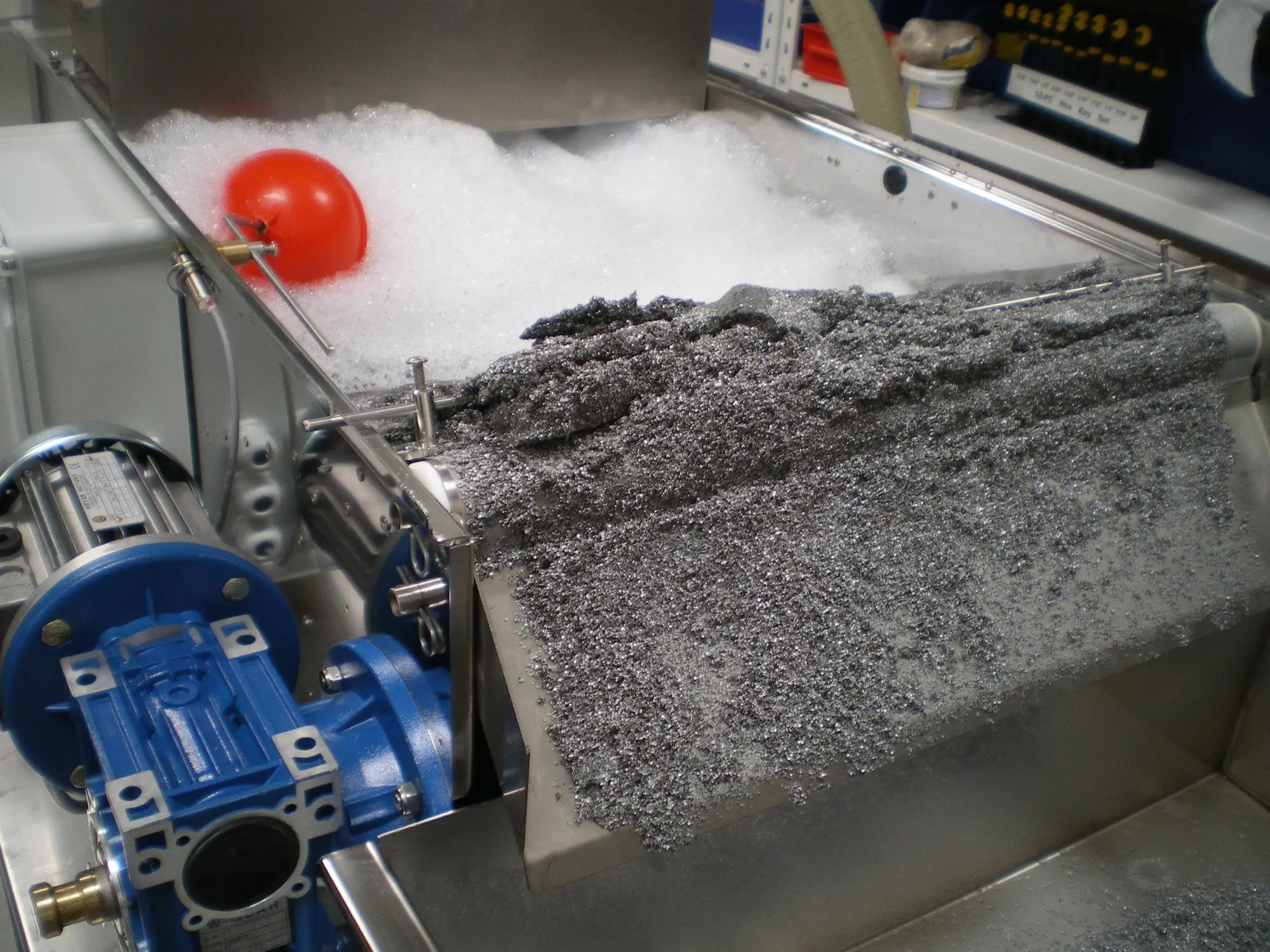
Belt filter in operation with filter paper and swarf from metalworking

The 7 series

The programme covers the three main materials — viscose, polyester and polypropylene — in five production methods. A full datasheet exists for every single weight.

UTV Viscose with binder

Viscose, acrylic-binder bonded · 20–60 g/m²

Soft, dimensionally stable filter medium for coarse and medium filtration in both gravity and vacuum filter systems. The economical standard choice for common coolants.

Turning · Drilling · Milling · Wire drawing (coarse/medium)

UTP Polyester, thermally bonded

Polyester spunbond, thermally bonded · 20–100 g/m²

Good dimensional stability and chemical resistance. A versatile series for medium and fine filtration — the broad choice for vacuum filter systems.

Drilling · Milling · Grinding · Vacuum filtration

UTH Polyester, high density

Polyester spunbond, high density · 30–70 g/m²

Dense polyester spunbond for fine filtration. Low air permeability and small pore size give efficient particle capture in precision machining.

Grinding · Honing · Lapping · Fine wire drawing

UTN Polyester, needle punched

Polyester, needle punched · 40–400 g/m²

Needle-punched polyester with a three-dimensional fibre structure. High load capacity and the widest weight range in the programme. Variants: K1 (standard fibre) and HF (finer fibre for finer filtration at the same weight).

Turning · Drilling · Milling · Grinding · Honing

UJet Polyester, spunlace

Polyester spunlace (hydroentangled) · 50–150 g/m²

Produced by hydroentangling: a uniform, stable fibre structure with good filtration properties in both gravity and vacuum filter systems.

Grinding · Honing · Milling · Precision machining

UFusion 3-layer gradient medium

Polyester, graded fibre structure (BICO fibre core) · 40–100 g/m²

Three-layer filter medium with a progressive fibre structure: coarse particles are captured in the open layers, fine ones in the dense layers. That increases capacity and extends service life — often with lower paper consumption than a single-layer medium for the same job.

Grinding · Honing · Lapping · Precision machining

UPP Polypropylene, thermally bonded

Polypropylene spunbond, thermally bonded · 20–70 g/m²

High chemical resistance to acids, alkalis and organic solvents. The right choice for aggressive cutting fluids and special applications where viscose and polyester do not hold up.

Drilling · Milling · Grinding · Aggressive process fluids
Full specifications — all 39 variants

Measured to DIN EN 29073 (weight, thickness, tensile strength, elongation) and EN ISO 9237 (air permeability). Pore size is stated as Bubblepoint/Meanflow.

Technical data per variant
VariantWeight g/m²Thickness mmTensile strength N/5cm (MD/CD)Elongation % (MD/CD)Air permeability L/m²/sPore size µm (BP/MF)
UTV 20200.1945/84/255,700190/85
UTV 25250.2050/94/265,400185/75
UTV 30300.2375/98/355,000125/70
UTV 35350.2765/125/284,400120/60
UTV 40400.3395/107/323,500120/60
UTV 50500.38100/147/353,000100/55
UTV 60600.45120/177/382,50095/50
UTP 20200.1641/3420/238,000200/110
UTP 30300.1570/6020/206,000190/100
UTP 40400.16110/9020/204,200180/100
UTP 50500.18140/12020/203,300150/70
UTP 60600.21175/14020/202,700120/60
UTP 70700.30170/13020/203,400140/70
UTP 80800.26230/20020/201,60075/45
UTP 1001000.32280/26020/201,30060/45
UTH 30300.3055/5520/204,200180/95
UTH 50 P500.48105/6534/331,90065/45
UTH 70 P700.40160/13035/401,30055/35
UTN 40 K1400.5145/6040/504,800164/70
UTN 60 K1600.8275/12045/754,100128/65
UTN 80 HF800.88125/13040/753,500105/65
UTN 1001000.90220/21032/712,50095/55
UTN 130 HF1101.14130/17050/953,000105/54
UTN 150 K11501.10330/34045/551,70089/50
UTN 3003001.80604/85855/6054065/40
UTN 4004002.30900/90045/6532055/30
UJet 50500.7090/9523/605,200145/75
UJet 70700.8099/6023/604,400110/70
UJet 1001001.06190/13033/623,150100/60
UJet 1501501.31370/36045/752,00095/54
UFusion 40400.4590/7525/255,700190/80
UFusion 70700.85170/15035/304,200165/60
UFusion 1001001.12250/22035/303,20095/55
UPP 20200.1931/2035/40>5,000230/100
UPP 30300.2575/4080/903,500140/70
UPP 40400.3580/5045/552,50090/50
UPP 50500.37120/7080/901,800100/55
UPP 70 DP680.35200/15035/353,900200/120
UPP 70700.45150/10090/1001,30095/60
MD = machine direction, CD = cross direction. BP = Bubblepoint, MF = Meanflow. All values are averages and subject to change without notice — the current datasheet is always the reference.

Frequently asked questions

What does the weight (g/m²) of filter paper mean?

The weight in g/m² is the weight of the medium per square metre and correlates with thickness and density. Higher weight typically means finer filtration and longer service life, but also a higher pressure drop. Our series cover 20–400 g/m² — the choice is always a balance between cleanliness, flow and price.

How fine are the particles a paper bed filter can remove?

With the right paper, a standard paper bed filter typically retains particles down to around 5 microns. If you need to go lower, for example in fine grinding or lapping, it takes special media or supplementary filtration.

Which filter paper is used for grinding?

Grinding typically calls for fine filtration (~50–100 µm). On gravity systems that is often UTV 60, UTN 130 HF, UJet 100 or UFusion 100. On vacuum systems often UPP 70, UJet 100 or UTN 130 HF. The final choice depends on the fluid and the surface requirements.

What is the difference between viscose, polyester and polypropylene?

Viscose is often the economical choice for ordinary jobs. Polyester has greater strength and chemical resistance and is used where the medium is heavily loaded. Polypropylene withstands acids, alkalis and organic solvents and is chosen for aggressive cutting fluids. The material is decided by fluid type, temperature and load.

Can I use the same paper in a gravity and a vacuum filter system?

Some series work in both system types, but not all weights are optimal in both. Vacuum systems pull the fluid through and can handle denser media, while gravity systems depend on the fluid flowing freely. Choose the weight to match the system, not just the filtration grade.

Why does the paper filter better once it is slightly dirty?

The particles already held in the medium help capture new ones — the so-called filter cake effect. A paper that is indexed too often is therefore not necessarily an advantage: it is about finding the right balance for your particular system.

Can I use a different paper from the one the machine was delivered with?

Yes, usually. Belt filter paper is not tied to the machine brand — what matters is dimensions, material and weight. Many save money by switching from the original brand to an equivalent. Send us the data of your current paper and we will match it.

What is the difference between UTN K1 and UTN HF?

Both are needle-punched polyester in the UTN series. K1 is the standard fibre; HF is a finer fibre that gives finer filtration at the same weight. Choose HF when you need to capture smaller particles without going up in weight.

Which filter paper width should I choose?

The width has to match your machine. We stock standard widths from 0.39 to 1.0 m; widths above 1 m are made to order. Send the machine type or the dimensions and we will find the right roll — width, length and core diameter.

How does the paper choice affect the service life of my coolant?

Cleaner fluid means slower degradation of the emulsion, fewer bacteria problems and less wear on pumps and tools. The right paper therefore often pays for itself on fluid economy alone.

Send the list. We will get back to you.

A filter list, a specification or a photo of the label on your current roll is enough. We compare it with the 7 series and come back with a recommendation and a price.

Or write to sales@unionoiltech.com