Varnish and MPC: when the oil lays down lacquer
Varnish is the cause of many sticking valves and turbines that will not start. It cannot be seen in the oil, and a standard particle count does not find it. Here is how varnish forms, which tests detect it and how it is removed.
What is varnish?
Varnish is a by-product of oil that oxidises and breaks down over time. It is a lacquer-like substance that starts dissolved in the oil and ends up as a hard coating on the system’s surfaces. Varnish has been a known problem in turbines, hydraulics and compressors for more than 30 years.
Oxidation is not the only cause. Varnish also forms through:
- electrostatic discharge and sparks in the oil
- micro-dieseling, where air bubbles are compressed and ignite
- hydrolysis, where water reacts with the oil
- high temperature and thermal degradation
- mixing of oils that are not compatible
- wear particles acting as a catalyst
How does varnish develop?
Varnish passes through several stages, and they are worth knowing because it is easiest to remove in the first:
| Stage | What happens | What you notice |
|---|---|---|
| Dissolved | Tiny clusters below 1 µm, dissolved in the oil | Nothing, the oil looks normal |
| Saturated | The oil can hold no more and deposits varnish on cool surfaces | Valves and spools become sluggish |
| Hard coating | The layer hardens and insulates, so the temperature rises | Higher operating temperature, filters block |
| Dislodged | Pieces of the layer break off and circulate as abrasive particles | Increased wear |
Varnish stays dissolved as long as the oil is hot. When the oil cools, for example during a shutdown, it settles on the cooler parts of the system: valves, spools and heat exchangers. That is why the problem often shows as valves sticking after a standstill, or a turbine that will not start.
In the later stages varnish becomes sticky. Particles and wear debris stick to it, and the clusters act like sandpaper in the system.
Which tests detect varnish?
| Test | Standard | What it shows |
|---|---|---|
| MPC | ASTM D7843 | The potential for insoluble varnish, measured as colour on a patch |
| S-MPC | Method from POLARIS Laboratories | Both dissolved and insoluble varnish |
| RPVOT | ASTM D7220 | The oil’s resistance to oxidation. Below 25 % indicates heavy oxidation |
| Ruler (LSV) | ASTM D6971 | How much of the oil’s antioxidants remain, as % of new oil |
| FTIR | ASTM E2412 | Oxidation and chemical changes in the oil |
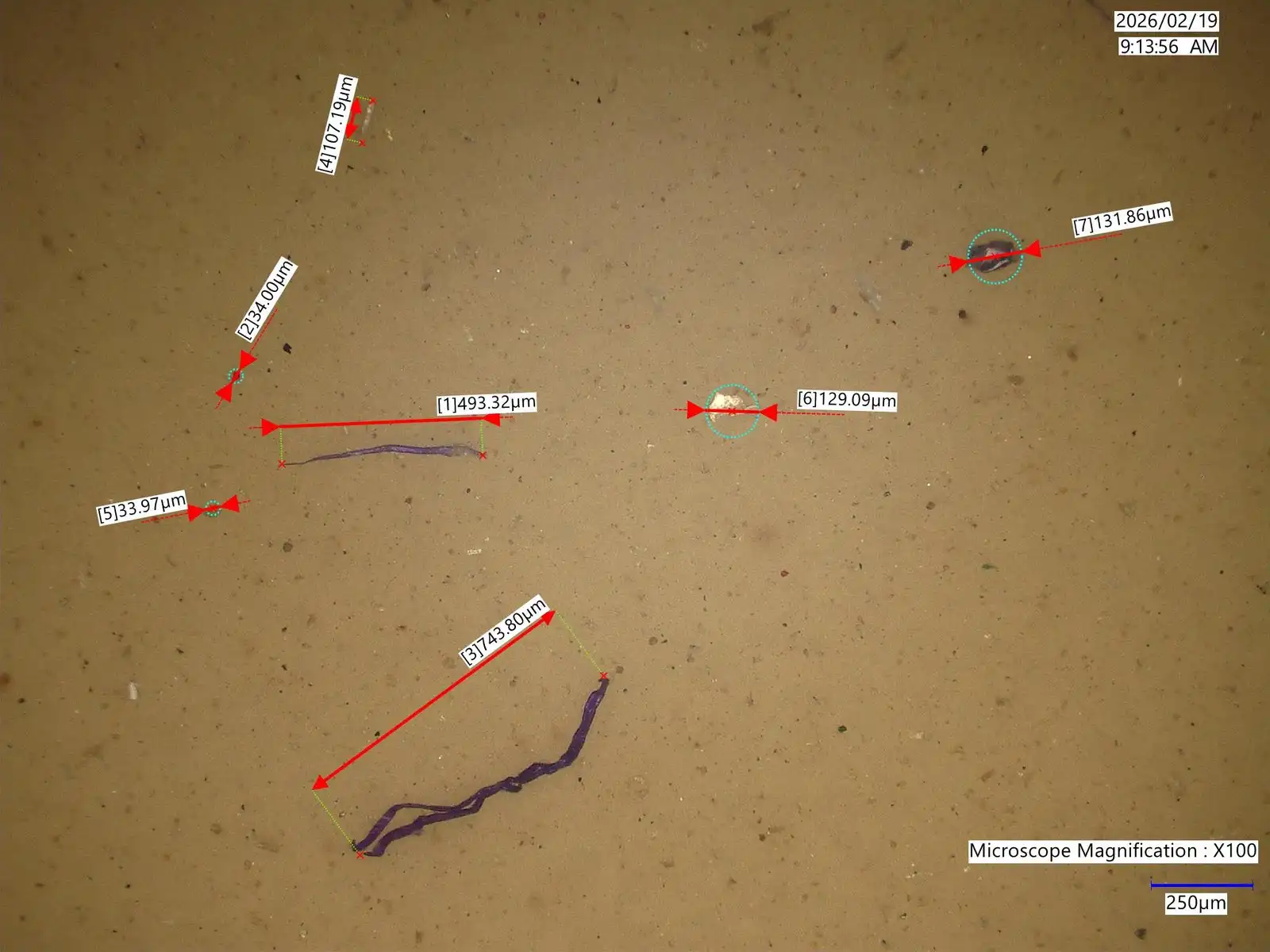
| Micropatch | Laboratory method | 1 ml of oil is filtered through a 0.8 µm patch and examined under a microscope |
Micropatch gives a picture of what is actually in the oil: varnish, carbon, oxides and wear. That is useful because elemental analysis does not see particles above about 8 to 10 µm.
What does the MPC figure mean?
The MPC figure rises the more varnish the oil can deposit. The laboratory assesses the figure based on the oil type and the system. The most important thing is the trend: a figure that rises from sample to sample is a warning, even before it reaches a critical level.
On a GT26 gas turbine with 28,000 litres of oil, MPC rose over one year. On 7 May 2024 an offline filter was fitted to the oil tank:
| Sample | MPC |
|---|---|
| July 2023 | 24 |
| The following samples | 38 and 30 |
| May 2024, before the filter | 52 |
| The following months | 21.3 and 16.8 |
| 1 August 2024 | 8.4 |
Before, ferrography showed varnish particles of 1 to 6 µm. After three months it showed none.
How do you remove varnish?
There are several methods: filtration, cleaning additives, ion exchange and changing to a different oil. Which works best depends on the type of varnish in the system. It is therefore worth having it analysed before the method is chosen.
With kidney loop filtration, the oil runs continuously through a cartridge that captures varnish and particles down to 0.1 µm. Because the oil is kept clean, it also starts to dissolve the varnish on the surfaces, and the cartridge captures it. The case studies show this:
| System | Measurement | Before | After |
|---|---|---|---|
| GT26 gas turbine | MPC | 52 | 8.4 |
| Wind turbine, gear oil | I-MPC (insoluble) | 23.2 | 3.6 |
| Wind turbine, gear oil | S-MPC (dissolved) | 21.8 | 10.9 |
| Hydraulic press | MPC | 45.9 | 3.5 |
In the gearbox of a smaller wind turbine, new oil was dark again 19 days after an oil change with flushing, because sludge and varnish from the surfaces contaminated it. After a year of filtration, the housing, gears and bearing surfaces were visibly cleaner, without anything else being done.
Varnish released from the surfaces can raise the figures in the samples for a while before they fall. That is a sign that the system is being cleaned, not that the oil is getting worse. In one wind turbine, the cartridge still captured varnish at operating temperatures above 80 °C.
Questions and answers
What is varnish in oil?
Varnish is a lacquer-like deposit that forms when oil breaks down through oxidation, heat, sparks or water. It starts as tiny particles dissolved in the oil and ends up as hard layers on valves, bearings and heat exchangers.
What does MPC measure?
MPC (ASTM D7843) measures the colour of a membrane patch the oil has been filtered through. The darker and more coloured the patch, the more insoluble varnish the oil can deposit. The figure is best used to follow the trend over time.
What is the difference between MPC and S-MPC?
MPC only detects varnish that is already insoluble. S-MPC is a method from POLARIS Laboratories that also detects dissolved varnish, the precursor before it settles. The oil is heated to 60 °C for 23 to 25 hours, and a drop is placed on a patch.
Can varnish be removed without changing the oil?
Yes. Kidney loop filtration captures varnish while the system runs. On a GT26 gas turbine, MPC fell from 52 to 8.4 in three months. Varnish released from surfaces in the system can temporarily raise the figure in the samples before it falls.
Documented in the case studies
Power generation
GT26 gas turbine: varnish figure from 52 to 8.4 in three months
528.4
MPC (varnish potential)
Read the caseWind turbines
Siemens 1.3 MW: 84 % less varnish in the gear oil while the turbine kept running
21/18/1115/14/11
ISO 4406 cleanliness code
Read the caseManufacturing and industry
Stadco: from weekly valve failures to two years without a single one
19/17/1214/12/09
ISO 4406 cleanliness code
Read the caseWant to know the figures for your own system?
We are happy to take a sample and go through the figures with you.